
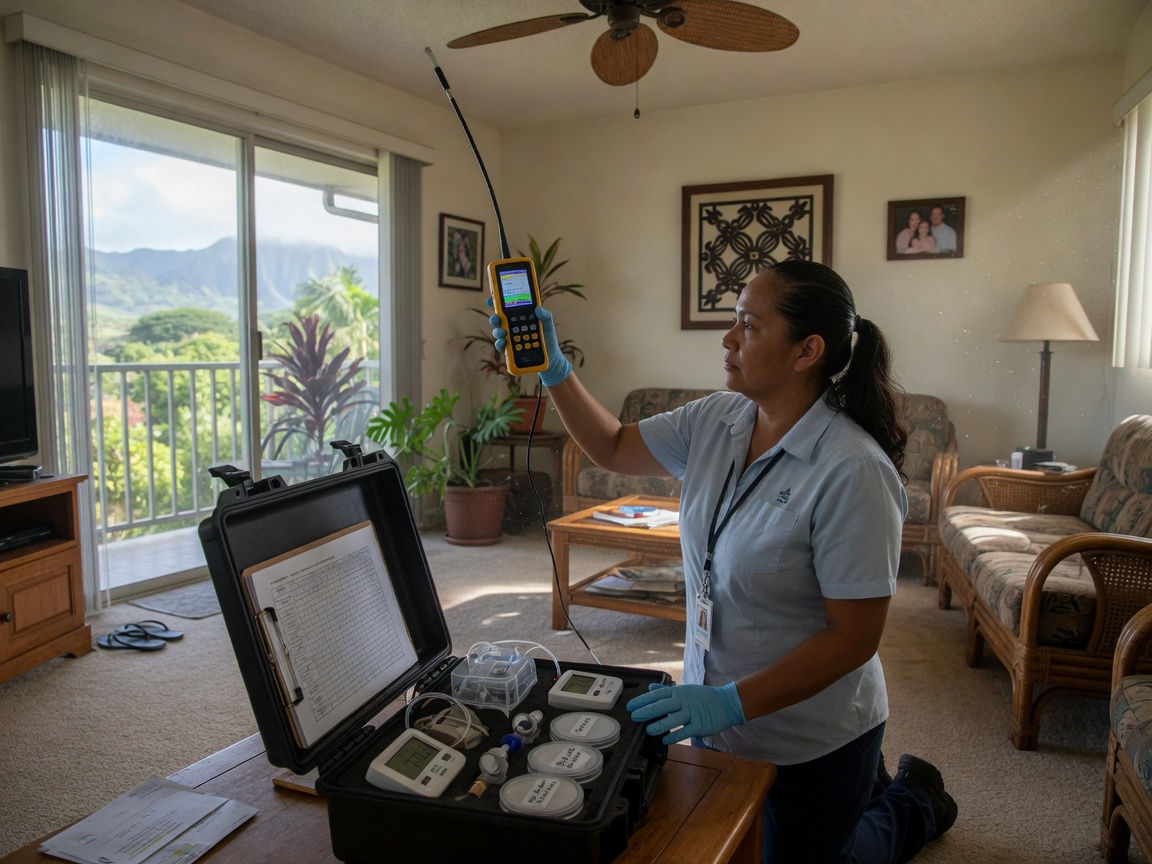
Kaneohe homes built before 1990 often have single-pane windows and minimal attic insulation that let trade-wind moisture seep into wall cavities and under-floor spaces. This constant humidity load, combined with organic debris blown in from Ho'omaluhia Botanical Garden and Mokolii Island, creates ideal conditions for mold growth on drywall and in duct insulation. Testing must include surface samples from these hidden areas rather than relying only on airborne counts taken at the return grille.
The same trade winds that cool the peninsula also carry pollen and salt aerosols from Kaneohe Bay directly into open lanai doors and bathroom exhaust vents. In Honolulu County, building code requires 1 cfm per square foot of continuous ventilation in new construction, yet many Kaneohe properties still rely on older bathroom fans that short-cycle during rain. Proper testing therefore logs CO2, relative humidity, and particulate levels over a full 24-hour cycle that includes both wind-driven and calm periods.
Kailua and Honolulu commuters who close their homes during the day trap cooking and cleaning vapors inside. When the afternoon trades resume, these concentrated pollutants get redistributed through the central air handler. Spot checks at the supply registers in living rooms and bedrooms reveal whether the system is spreading or diluting indoor contaminants.
Soil conditions near the bay are often saturated; slab-on-grade homes can draw radon and moisture vapor through hairline cracks. A thorough test includes a sub-slab pressure measurement and checks for musty odors at baseboards, especially after heavy rain when the water table rises.
Technician insight
In Kaneohe the thing that catches most people out with Indoor Air Quality Testing is how the afternoon trade winds push bay moisture under the house and into the return plenum; if you only sample the living room you miss the real source.
Kaneohe Bayfront Home
A single-story Kaneohe house two blocks from the bay showed persistent musty smells despite new AC filters. Testing found elevated aspergillus in the master bedroom supply and 68 % relative humidity under the slab. We mapped the moisture, recommended sealing the crawlspace vents, and retested after the homeowner added a dehumidifier; levels dropped below outdoor baselines within ten days.
Indoor Air Quality Testing Services We Offer
✓Mold Spore Air Sampling
Collects air and surface samples from Kaneohe homes to identify mold types amplified by year-round humidity near Kaneohe Bay.
✓Humidity and Moisture Mapping
Uses pin and pinless meters plus thermal imaging to locate hidden dampness in older single-wall construction common in Kaneohe.
✓VOC and Chemical Screening
Tests for off-gassing from household products and building materials that accumulate when trade winds are blocked by closed windows.
✓Allergen and Pollen Count
Measures outdoor pollen and dust brought indoors by prevailing trades from Ho'omaluhia Botanical Garden and surrounding vegetation.
✓Carbon Monoxide and Gas Detection
Checks combustion appliances and attached garages for CO migration, a risk in Kaneohe’s older carports and attached utility rooms.
✓Ductwork Contaminant Inspection
Inspects supply and return ducts for accumulated dust, insulation fibers, and microbial growth pushed by constant fan operation.
Indoor Air Quality Testing Cost in Kaneohe, HI
| Service | Typical Range | What Affects It |
|---|---|---|
| Basic airborne mold and allergen panel | $250–$350 | Two samples plus humidity reading; common for first-time checks in single-story Kaneohe homes. |
| Comprehensive multi-zone test | $450–$650 | Six to eight samples plus 24-hour data logging; typical for two-story homes near the bay. |
| Add-on CO and VOC screening | $125–$175 | Added when gas appliances or recent renovations are present. |
| Follow-up post-remediation verification | $200–$300 | Confirms mold levels after remediation in the same property. |
Ranges are typical for Kaneohe, HI and confirmed with an exact written quote before any work starts.
How it works
- 1
Initial Walk-Through
Technician reviews home layout, HVAC system age, and any musty odors reported near Kaneohe Bay-facing rooms.
- 2
Multi-Point Sampling
Air and surface samples are taken at supply registers, returns, and suspected moisture areas while logging humidity and CO2 over several hours.
- 3
Laboratory Analysis
Samples are sent to an accredited lab for mold, allergen, and VOC identification.
- 4
Report And Recommendations
Written findings include specific remediation steps tailored to Kaneohe’s trade-wind and humidity patterns.
Pricing
Most Kaneohe indoor air quality tests fall between $250 and $650 depending on the number of samples and whether overnight humidity logging is required.